
Furthering the Discussion of Collage Art and Navigating the Ephemeral Universe
- Bobby Padilla

- Feb 20
- 5 min read
Collage art can feel like stepping into a vast universe of fragments, textures, and stories. For those just starting out, gathering source material might seem overwhelming, while experienced artists often seek fresh inspiration or new techniques. This post explores practical ways to collect materials, highlights seven historical and contemporary collage artists, and compares their work with that of mine. I'm been working as a Rochester-based artist known for his mixed media and collage creations, for most of career. Along the way, we’ll peek at some of my intriguing pieces, (If I do say so myself), and offering encouragement and insight for all collage enthusiasts. Some of which I have referenced in previous post. With a healthy dash of ego, I will dare to insert myself in the collage discussion amongst those artists with far more notoriety than myself. This is also a good exercise for anyone starting out, and it's a great way to point your interests in the directions that you want your art to go.
Gathering Source Material for Collage Art
Starting your collage journey means becoming a collector of moments, images, and textures. Here are some best practices:
Be curious everywhere: Old magazines, newspapers, fabric scraps, ticket stubs, postcards, and even packaging can become part of your visual vocabulary.
Organize your finds: Use folders, envelopes, or digital scans to keep track of your materials. This makes it easier to find the perfect piece when inspiration strikes.
Look beyond paper: Collage can include fabric, metal, wood, or natural elements like leaves. Experimenting with different textures adds depth.
Respect copyrights: Use public domain images or your own photos to avoid legal issues.
Keep a sketchbook or digital mood board: Jot down ideas or combine images digitally before committing to glue and scissors. It's ok to record very loose ideas and incomplete thoughts as "sketches" in a sketchbook. Traditionally, you work thoughts and ideas in a sketchbook in the form of preliminary drawings and studies. Then, these sketches can be developed into more fully realized and complete pieces.
For experienced artists, pushing boundaries might mean sourcing from unusual places like thrift stores, flea markets, or even creating your own prints and photographs to collage.
Seven Collage Artists to Know
Exploring the work of other artists can spark new ideas and techniques. Here are seven collage artists, past and present, whose work offers a wide range of styles and approaches:
1. Hannah Höch (1889–1978)
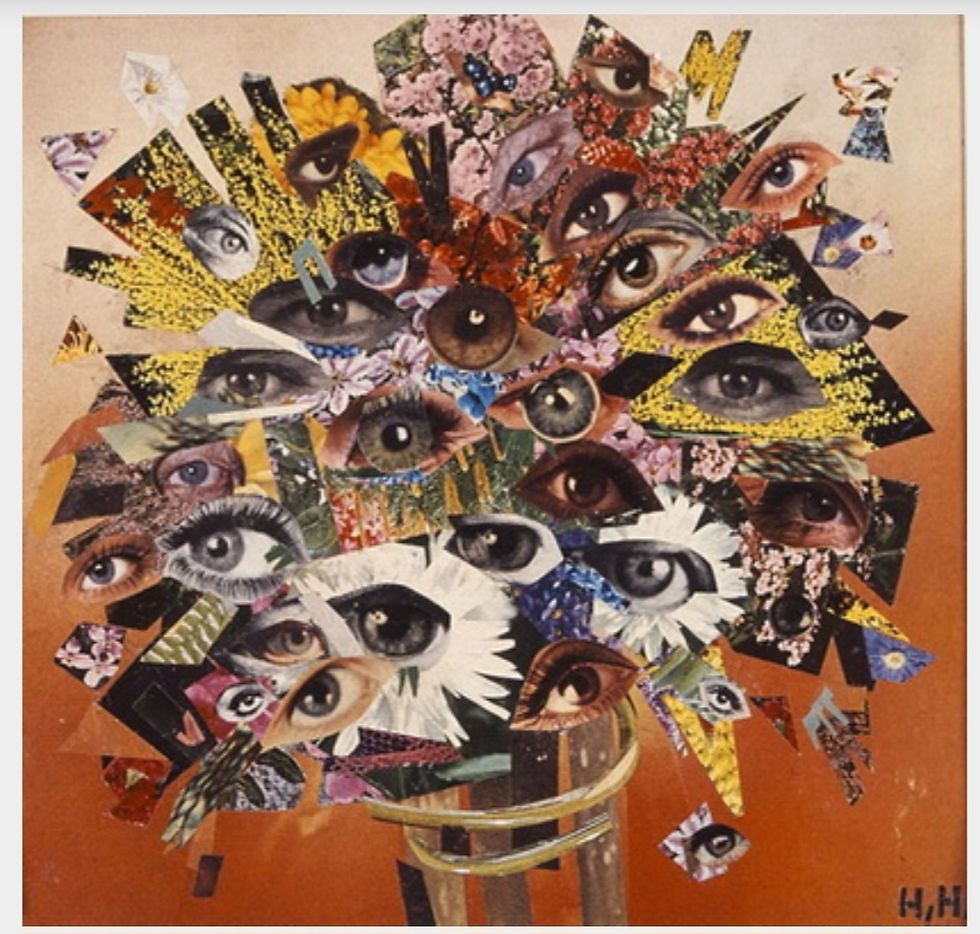
Strauss, 1965
A pioneer of photomontage, Höch used cut-out photographs and text to challenge social norms in early 20th-century Germany. Her work often combined political commentary with surreal juxtapositions.
2. Romare Bearden (1911–1988)

Prevalence of Ritual III
Bearden’s collages celebrate African American culture through vibrant compositions using painted paper, photographs, and fabric. His work blends storytelling with abstract forms.
3. Joseph Cornell (1903–1972)

Object (Abeilles)
Known for his shadow boxes, Cornell’s collages are three-dimensional, combining found objects and images to create dreamlike narratives.
4. Wangechi Mutu (b. 1972)

Family Tree, 2012
A contemporary artist, Mutu’s collages mix magazine cutouts, paint, and drawing to explore identity, gender, and post-colonial themes with a surreal edge.
5. Mark Bradford (b. 1961)

May Heaven Preserve You From Danger and Assissans, 2010
Bradford uses layers of paper, posters, and paint scraped and reassembled to reflect urban life and social issues. His large-scale collages have a raw, textured quality.
6. Kara Walker (b. 1969)

Exodus of Confederates from Atlanta, 2005
Walker’s silhouette cut-paper collages confront race, history, and power dynamics with stark black-and-white imagery that is both beautiful and unsettling.
7. Mickalene Thomas (b. 1971)

Melody :Back, 2011
Thomas combines rhinestones, acrylic, and collage to create vibrant portraits that celebrate Black femininity and challenge traditional beauty standards.
Bobby Padilla

Have You Ever Heard the Sound of Blue Laughing it Way Through the Sky?
Mixed media and collage on heavyweight black Strathmore, 16"x20"
Comparing my Work to These Artists
My collage and mixed media pieces, such as Have You Ever Heard the Sound of Blue Laughing It’s Was Through the Sky and Dreamt, reveal a unique voice rooted in Rochester’s urban and cultural landscape and reverberates with a deep personal narrative. My work often blends found paper, paint, and text fragments to create layered moments that feel both personal and universal.
Like Romare Bearden, I uses vibrant colors and cultural references, but my approach leans more toward abstraction and texture than direct storytelling. My piece Sugarhawk shows a playful yet thoughtful arrangement of shapes and colors, reminiscent of Mark Bradford’s textured surfaces but with a lighter, more whimsical touch.

Sugarhawk, 2024 Mixed media and collage on black Strathmore heavyweight paper
My City Central Paradise and Lovers, Angels and a House of Cards echo Joseph Cornell’s dreamlike quality, but instead of shadow boxes, my work remains flat, inviting viewers to explore the surface complexity. My use of text fragments adds a poetic layer, similar to Hannah Höch’s photomontages, but with a more of a contemporary urban flavor.

City Central Paradise, 2024
Mixed media and collage on Strathmore heavyweight paper

The pieces The Sand Make’s Promises the Stars Won’t Keep and Wooden Dolls Over a Fireplace showcase the balance of chaos and order, much like Wangechi Mutu’s surreal collages, but with a distinct etheral grit and warmth.

The Sand Make's Promises the Stars Won't Keep, 2024 Mixed media and collage

Wooden Dolls Over a Fireplace, 2024 Mixed media and collage on Strathmore heavyweight paper
Tips for Navigating the Technical Side of Collage
Collage can range from simple paper layering to complex mixed media constructions. Here are some tips to handle this range:
Start simple: Cut and paste images to get a feel for composition before adding paint or other media.
Use quality adhesives: Acid-free glue sticks or archival sprays help preserve your work.
Experiment with layering: Transparency and overlap create depth. Try tissue paper or vellum for subtle effects.
Balance chaos and control: Let some elements be spontaneous, but plan focal points to guide the viewer’s eye.
Incorporate text thoughtfully: Words can add meaning or texture but avoid clutter.
Protect your work: Use fixatives or frame under glass to keep delicate materials safe.
My process reflects these principles. I embraces imperfection and spontaneity but also carefully considers color harmony and texture balance. My work encourages beginning artists to trust their instincts while honing their craft.
Bobby Padilla,

Encouragement for New and Experienced Collage Artists
Collage art invites you to explore the ephemeral—moments, memories, and materials that might otherwise be discarded. Whether you’re just starting or have years of experience, remember:
There is no right or wrong: Collage is about discovery. Mistakes often lead to breakthroughs.
Your materials tell a story: The source of your images adds layers of meaning.
Keep experimenting: Try new textures, scales, or themes to keep your work fresh.
Look at other artists: Study how they use space, color, and narrative.
Share your work: Feedback can open new perspectives and connections.
My art shows that collage can be a personal journey and a community conversation. My work is a reminder that even the most fragmented pieces can come together to create something meaningful and beautiful.
Bobby Padilla

R.E.M Rhaposodic, 2024
Mixed media and collage on Coroplast


Thanks for the kind words!
What a lovely blog I never seen those artists before, also loved your beautiful works ❤️